!
Latest updates
How to Get to Koh Lanta: Flights, Roads and Ferries
Updated 8th Sep 2026
Things to Do on Koh Lanta: Diving, Old Town and the National Park
Updated 8th Sep 2026
Krabi Province Guide: Airport, Krabi Town and Choosing a Base
Updated 8th Sep 2026
Thailand for couples: which islands and parks close, and when
Updated 8th Sep 2026
Thai domestic flight tickets: fare rules, baggage deadlines and passenger rights
Updated 8th Sep 2026
Bangkok Flights. Information on Flights to and from Bangkok
Updated 3rd Sep 2026
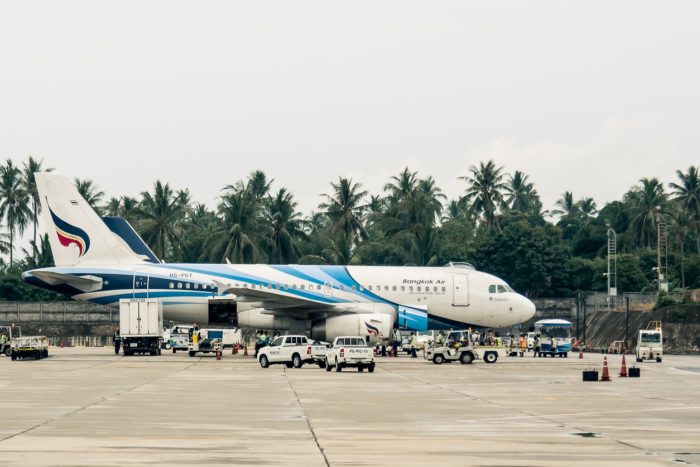
Bangkok is the hub of Thailand's domestic flight network, with 26 destinations reachable by direct flight from one of its two airports as of September 2026. This guide groups them the way a traveller actually thinks about them: north, north-east, south and the islands, and east. It then covers how long each leg takes, which airport question actually matters, and the seasons that can disrupt a flight.
Where you can fly from Bangkok
The 26 destinations below had scheduled nonstop service from one of Bangkok's airports when checked on 3 September 2026, grouped by region rather than by airline or airport.
| Region | Destinations |
|---|---|
| North | Chiang Mai, Chiang Rai, Lampang, Mae Sot, Nan, Phitsanulok, Sukhothai |
| North-east (Isan) | Udon Thani, Ubon Ratchathani, Khon Kaen, Buriram, Roi Et, Sakon Nakhon, Nakhon Phanom, Loei |
| South and the islands | Phuket, Krabi, Koh Samui, Hat Yai, Surat Thani, Nakhon Si Thammarat, Trang, Ranong, Chumphon, Narathiwat |
| East | Trat |
Roughly how long each flight takes
No airline or Airports of Thailand publishes a flight-duration figure for its domestic routes, so every time below is an estimate built from aggregated schedule data, not a timetable entry.
The shortest domestic legs out of Bangkok run around an hour. Bangkok to Trat takes about 1 hour, Bangkok to Khon Kaen about 1 hour to 1 hour 10 minutes, and Bangkok to Ubon Ratchathani and Bangkok to Udon Thani both about 1 hour 5 to 1 hour 10 minutes.
To the north, Bangkok to Chiang Mai runs about 1 hour 15 to 1 hour 25 minutes, and Bangkok to Nan is similar, at about 1 hour 15 to 1 hour 20 minutes. Bangkok to Mae Sot is shorter, at about 55 minutes to 1 hour 10 minutes.
To the south and the islands, Bangkok to Phuket and Bangkok to Krabi both run roughly 1 hour 20 to 1 hour 35 minutes, and Bangkok to Hat Yai and Bangkok to Surat Thani both take about 1 hour 10 to 1 hour 35 minutes. Bangkok to Chumphon is shorter, at about 1 hour 5 minutes.
Bangkok to Koh Samui has the widest published range, about 1 hour to 1 hour 35 minutes, because Bangkok Airways is the only airline that operates this route and the figure reflects its own schedule window. Bangkok to Narathiwat, in the far south, is the longest domestic leg in the network, at around 1 hour 30 minutes.
The remaining destinations were not checked individually for this page, so no figure is given for them here. Where one sits close to a destination that was checked, expect a broadly similar range: Chiang Rai is near Chiang Mai, and Nakhon Si Thammarat, Trang and Ranong sit close to Surat Thani and Hat Yai. As a rule of thumb, most of this network is a flight of around an hour to an hour and a half.
Choosing between Suvarnabhumi and Don Mueang
Bangkok Suvarnabhumi Airport (BKK) and Bangkok Don Mueang Airport (DMK) are organised on opposite systems by the same operator. Don Mueang splits into Terminal 1 for international flights and Terminal 2 for domestic ones, while Suvarnabhumi has a single passenger terminal serving both, with no numbered domestic-international split.
Don Mueang carries more of the low-cost domestic network, and Suvarnabhumi is the full-service, international-transfer gateway, but some airlines use both and the split is not fixed. Which airport a route flies from can change over time, so check Thailand's regional airlines comparison or the airline's own page before assuming last year's airport still applies.
This page does not try to say which airport a specific airline uses for a specific route, because that assignment can change and each airline's own page is where it is answered. Bangkok Airways, for instance, has a dedicated page covering exactly that question for its own network.
A domestic flight booked as a separate ticket from an international arrival is not automatically a protected connection. Only a handful of Thai airports allow checked baggage to be carried straight through from an international flight to a domestic one, and Don Mueang is not among them, so a domestic leg from there after an international arrival usually means collecting your bags and re-checking in. International transfers between Suvarnabhumi and Don Mueang covers the mechanics for connecting passengers in full.
For getting between either airport and the city itself, Getting Around Bangkok covers that in depth; this page sticks to the flights.
Read more about each airport, including how to reach it, on the Bangkok Suvarnabhumi Airport and Bangkok Don Mueang Airport pages.
What to check before every domestic flight
Foreign nationals must show a passport, or another accepted government-issued photo ID, to board a domestic flight in Thailand. This has been a standing requirement since a tightening of the rule in January 2024, and Airports of Thailand's own guidance confirms it applies today.
Thailand's liquids, gels and aerosols rule applies to domestic flights as well as international ones. Under the rule the Civil Aviation Authority of Thailand (CAAT) introduced in April 2025, each container may hold no more than 100ml, the total across all containers may not exceed 1,000ml per passenger, and they must be carried together in a single transparent resealable bag shown separately at screening.
Check-in and bag-drop close at a fixed interval before departure, and arriving after that point risks missing the flight, with airlines rarely making an exception. Build in a larger margin during the high season, when queues at both airports run longer.
Seasons that affect flying
The burning season affects the north's airports specifically. In 2026, Thailand's air navigation authority confirmed that flights into Chiang Mai, Chiang Rai, Lampang, Tak and Mae Hong Son kept running safely, even as visibility fell as low as about 1,200 metres against the 800-metre minimum needed for an instrument landing, and it ran contingency planning that included possible diversions.
The haze has forced an outright route suspension before. Bangkok Airways suspended its Lampang to Mae Hong Son leg for over a month in spring 2025 over worsening visibility from wildfire haze, while its direct Bangkok to Lampang service kept running. The worst of the haze typically runs from February to April, peaking in March.
The rainy season runs roughly from May to October, and afternoon storms are a known feature of it that can disrupt any flight's schedule. High season, from December through early April and again around the mid-April Songkran holiday, is when the network is busiest and seats go first.
Frequently asked questions
Which Bangkok airport should I use for a domestic flight?
It depends on the airline and the route, and the assignment is not fixed from one year to the next. Check Thailand's regional airlines comparison guide or the airline's own page before you book, rather than assuming last year's airport still applies.
Do I need a passport for a domestic flight within Thailand?
Foreign nationals do. It has been a standing requirement since a tightening of the rule in January 2024, and it applies today.
Can I carry liquids through airport security for a domestic flight?
Yes, under the same limits used for international departures: up to 100ml per container and 1,000ml in total per passenger, carried in a single transparent resealable bag. This rule took effect in April 2025, so confirm nothing has changed with the airport or your airline before you travel.
Does the seasonal haze in northern Thailand affect flights?
It can. Visibility around Chiang Mai, Chiang Rai, Lampang, Tak and Mae Hong Son can drop sharply during the February to April burning season, and Thailand's air navigation authority has run contingency planning for it, including possible diversions, without those airports actually closing in 2026.