!
Latest updates
How to Get to Koh Lanta: Flights, Roads and Ferries
Updated 8th Sep 2026
Things to Do on Koh Lanta: Diving, Old Town and the National Park
Updated 8th Sep 2026
Krabi Province Guide: Airport, Krabi Town and Choosing a Base
Updated 8th Sep 2026
Thailand for couples: which islands and parks close, and when
Updated 8th Sep 2026
Thai domestic flight tickets: fare rules, baggage deadlines and passenger rights
Updated 8th Sep 2026
Krabi Destination Guide
Updated 8th Sep 2026
Krabi is a province on Thailand's Andaman coast, known for limestone karst towers that NASA's Earth Observatory describes as ancient sea-bed deposits uplifted and eroded into towers, caves and cliffs. Krabi town, the provincial capital, works mainly as a transit point rather than a destination, and many visitors move straight on to Ao Nang, Koh Lanta or Koh Phi Phi. This guide covers the airport, Krabi town itself, and how Ao Nang, Koh Lanta and Koh Phi Phi compare as somewhere to stay.
Getting to Krabi province by air
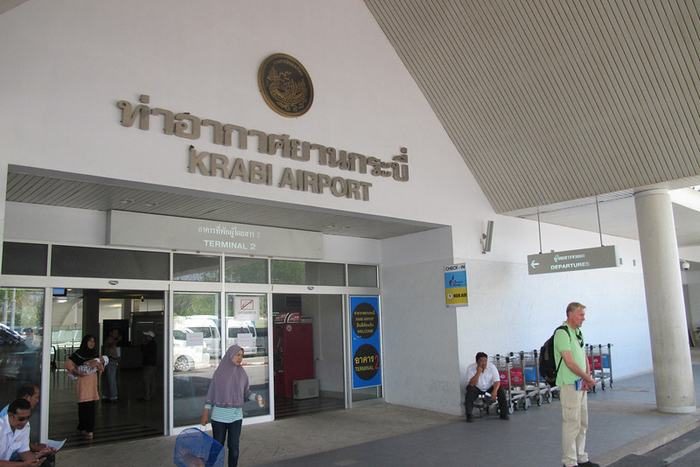
Krabi Airport (KBV) is the province's own gateway, operated by the Department of Airports rather than Airports of Thailand; a 2022 plan to transfer it to Airports of Thailand, alongside Udon Thani and Buri Ram, was indefinitely postponed in March 2025. A terminal expansion opened officially in October 2025, raising the airport's stated capacity from four million to eight million passengers a year.
As of the Department of Airports' own open-data records, covering January and February 2026, scheduled domestic carriers into Krabi include Thai AirAsia, Thai Vietjet Air, Nok Air, Bangkok Airways, Thai Airways and Thai Lion Air. Travellers connecting through Bangkok or Chiang Mai can compare schedules on the Bangkok to Krabi and Chiang Mai to Krabi route pages. The Krabi Airport page covers ground transport into Krabi town and Ao Nang, along with the airport's own facilities.
Phuket International Airport (HKT) is the realistic alternative gateway, reached overland around Phang Nga Bay on Highway 4. Route planners put the drive at around 138 kilometres and just over two hours, consistent with a coastal road that has to detour around the bay rather than running in a straight line. The Phuket International Airport page and the Phuket Destination Guide have more on that option.
Krabi town: landmarks and character
Krabi town is the provincial capital, sited where the Krabi River meets Phang Nga Bay. It is not a beach destination in itself, and it works mainly as a transit point on the way to Ao Nang, Koh Lanta or Koh Phi Phi rather than a place to stay.
The town's clearest landmark is Khao Khanap Nam, a pair of limestone karst peaks roughly 100 metres high that straddle the Krabi River and are often described as a symbol of Krabi. A longtail boat from the town's Chao Fa Pier reaches them in about 15 minutes, and the peaks hold caves with stalactites, stalagmites and archaeological exhibits.
The Krabi River itself is short, around 5 kilometres of main channel, but its estuary is a Ramsar-listed wetland covering 213 square kilometres, including more than 100 square kilometres of mangrove forest. A night market runs daily beside Chao Fa Pier from around 5pm until late, and is described as the town's largest street-food market.
North-northeast of the town is Tiger Cave Temple (Wat Tham Sua), a Theravada Buddhist temple founded in 1975 by the monk Ajahn Jumnean Seelasettho. A stairway of 1,260 steps climbs to a summit at 278 metres, and a separate, shorter stairway of 184 steps leads to a lower monks' area.
Choosing a base in Krabi province
Ao Nang is the most developed of the three, with the province's busiest concentration of tourist infrastructure. The Ao Nang Krabi Destination Guide has more on staying there.
Koh Lanta is generally the quieter, more family-oriented island of the three: developed enough to be comfortable, without Phuket's crowds or Koh Phi Phi's nightlife reputation. The Koh Lanta Destination Guide covers getting there and choosing a beach, and Koh Lanta: A Hidden Treasure Near Krabi covers what there is to do once you arrive.
Koh Phi Phi is the boat-only option: there is no airport on the islands themselves, so the nearest airport is Krabi, and the islands carry a nightlife and backpacker reputation. The Koh Phi Phi Destination Guide covers Phi Phi Don, Phi Phi Leh and Maya Bay.
Moving on from Krabi town
Ao Nang is a short drive from Krabi town by road. Boats to the islands leave from Khlong Jilad Pier in Krabi town, a different jetty from the one used for the shorter longtail crossing out to Khao Khanap Nam.
Koh Lanta is reached either by road with a car ferry crossing or by a more direct sea ferry. A 2.24-kilometre cable-stayed bridge linking the mainland at Koh Klang to Koh Lanta Noi has been contracted but not yet built: Thailand's Rural Roads Department signed the construction contract on 31 August 2026, with construction expected to take around three years and an opening targeted for 2029, when the bridge will replace the car ferry crossing. The Koh Lanta Destination Guide sets out which of these runs, and when.
Koh Phi Phi has no road option at all: it is reached only by boat, with a crossing of roughly two hours from Krabi town's own pier. Boats run daily in most conditions, though service can thin in the monsoon months, and sailings on from Phi Phi to Koh Lanta run less often outside the high season, so check the operator for the day you plan to travel. The Koh Phi Phi Destination Guide has more on arrival.
When to go
The Andaman coast has a wet season running roughly from May to October, when Thailand's Meteorological Department issues periodic wind and wave warnings for the upper Andaman Sea, sometimes reporting wave heights of two to three metres and advising small boats to stay ashore. Ferry schedules thin out during this period, and several published timetables for routes around Krabi are marked as high season only, so it is worth checking directly with the operator for the date you plan to travel.
Some outlying islands close entirely during the wet season: Mu Ko Lanta National Park's outer islands, including Ko Rok and Ko Hin Daeng, are closed each year from 16 May to 31 October by the Department of National Parks, and for shorter windows by the National Park Office, whose published dates differ, so check which applies before booking a day trip out there. Box jellyfish have been reported around Ko Lanta and inside the Hat Noppharat Thara-Mu Ko Phi Phi National Park, more often in the monsoon months. In June 2026, both parks temporarily banned swimming at affected beaches after Portuguese man o' war were washed ashore, so posted warnings and lifeguard guidance should always be followed.
Frequently asked questions
Is Krabi town worth visiting on its own?
Krabi town is not a beach destination in itself, and it works mainly as a transit point on the way to Ao Nang, Koh Lanta or Koh Phi Phi. It does have its own attractions, including the limestone peaks of Khao Khanap Nam, reached by longtail boat from Chao Fa Pier, and Tiger Cave Temple to the north-northeast of town.
Should I stay in Krabi town or Ao Nang?
Krabi town works best as a short, practical base near the airport and the inter-island ferry pier, since it is not a beach destination. Ao Nang is the better choice if you want a beach holiday rather than a transit stop; the Ao Nang Krabi Destination Guide has more on what it offers.
How do I get to Koh Lanta from Krabi?
Koh Lanta is reached from Krabi either by road with a car ferry crossing or by a more direct sea ferry, and which one runs, and how often, changes with the season. The Koh Lanta Destination Guide has the route options and when each one operates.
What is the best time of year to visit Krabi province?
Outside the wet season, roughly May to October, seas on the Andaman coast are generally calmer and boat schedules run closer to normal. During that period, Thailand's Meteorological Department issues periodic wind and wave warnings for the Andaman Sea, ferry schedules thin out, and some of the more remote islands close outright.