!
Latest updates
How to Get to Koh Lanta: Flights, Roads and Ferries
Updated 8th Sep 2026
Things to Do on Koh Lanta: Diving, Old Town and the National Park
Updated 8th Sep 2026
Krabi Province Guide: Airport, Krabi Town and Choosing a Base
Updated 8th Sep 2026
Thailand for couples: which islands and parks close, and when
Updated 8th Sep 2026
Thai domestic flight tickets: fare rules, baggage deadlines and passenger rights
Updated 8th Sep 2026
Chiang Mai's Food Odyssey: Street Eats to Gourmet Feasts
Updated 3rd Sep 2026
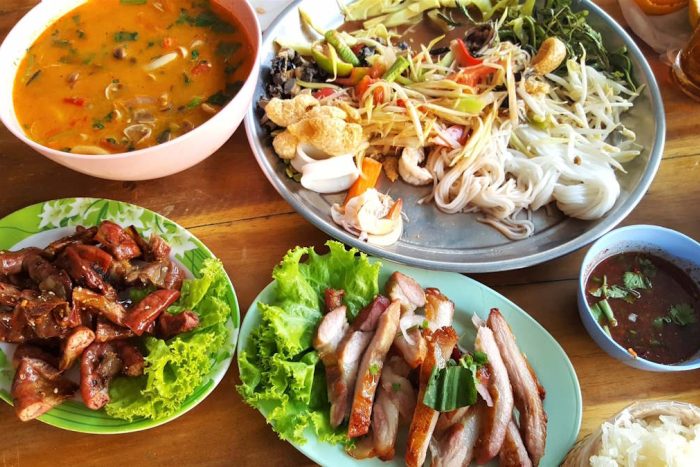
Northern Thai food is its own kitchen: it leans less on coconut milk than the central and southern cooking a visitor is more likely to have met, runs less sweet and generally less chilli-hot, and builds its flavour from herbs, bitterness and pickled and fermented ingredients. Sticky rice is the staple here rather than jasmine rice.
Lanna, the northern kingdom Chiang Mai was the capital of, was under Burmese rule and sat on the caravan routes out of Yunnan, and the food carries Burmese, Shan and Yunnanese Chinese-Muslim influences from both. This page covers what the dishes are and where they came from, which market runs on which night, what the autumn Vegetarian Festival changes, and the months when eating outdoors means eating in smoke.
It works from dishes, markets and market days rather than restaurant names, because restaurant lists date faster than market days do. Getting here is another page's subject: the Chiang Mai flights guide covers who flies in and from which of Bangkok's two airports, and the Bangkok to Chiang Mai route page carries the schedule data for the route.
The dishes, and what is actually in them
Two dishes do most of the work for a visitor here, for opposite reasons: khao soi is the one people arrive already knowing the name of, and larb khua is the one where what arrives is not what the name has led you to expect.
Khao soi
Khao soi is egg noodles in a coconut curry broth, topped with a nest of deep-fried crisp noodles and served with pickled mustard greens, shallots, lime and chilli oil. It evolved from the cooking of Chin Haw Muslim traders from Yunnan, who worked the caravan routes through Myanmar, Laos and Thailand between the eighteenth and the early twentieth centuries, when what is now northern Thailand was under Burmese control.
The Lao dish of the same name is a different thing entirely: hand-sliced rice noodles in a clear broth under a minced pork and tomato sauce with fermented bean paste. Ordering khao soi by name across the border gets you that instead.
Kaeng hang le
Kaeng hang le is a slow-stewed pork belly curry with ginger, turmeric, tamarind, pickled garlic, peanuts and a masala spice mix, traditionally made without coconut milk, though modern versions add it. It came from Myanmar, probably with the Shan, and the name derives from the Burmese hin lay, meaning heavy curry. Chiang Mai restaurants often list it as Burmese curry.
Larb khua
The northern larb is cooked rather than raw and is made without lime juice, so it is neither sour nor fresh in the way the north-eastern Isaan version is. It is the same name applied to a different dish, so what arrives is not what someone who knows larb from Isaan is expecting.
The rest of the northern list
| Dish | What it is |
|---|---|
| Sai ua | Grilled pork sausage worked with lemongrass, galangal, kaffir lime leaf and dried red chilli, associated with the Lanna kingdom period |
| Nam prik ong | A cooked dip of minced pork, tomato, dried red chilli, shallot and garlic with fermented soy bean or shrimp paste, closer to a ragu than a sauce |
| Nam prik num | A dip of roasted young green chilli with garlic and shallot, hotter than nam prik ong |
| Khanom jeen nam ngiao | Thin rice noodles in a tomato-based pork or beef broth flavoured with the dried dok ngiew, or kapok, flower, usually with cubes of pork blood. A breakfast dish |
| Khao kha moo | Braised pork leg over rice with stewed greens and a boiled egg, sold from stalls rather than restaurants |
Northern cooking uses pork blood, fermented fish and offal openly, and a stall's English menu will not always say so. Nam ngiao normally carries cubes of set pork blood, and nam prik ong is usually built on a fermented soy bean or shrimp paste. Ask if that matters to you.
Which market, which night
The market calendar is worth planning a trip around, because the two big walking streets are fixed to a day of the week. The other three markets below run daily or nightly.
| Market | When | Where it is |
|---|---|---|
| Wualai Walking Street | Saturdays, from late afternoon | Wualai Road, opposite Chiang Mai Gate |
| Sunday Walking Street | Sundays, from late afternoon, with music and dance later in the evening | Ratchadamnoen Road, running west from Tha Phae Gate |
| Warorot Market | Daily, early morning to mid-afternoon | Wichayanon Road, Chang Moi, beside the river |
| Chang Phueak Gate night market | Daily, from late afternoon into the late evening | Outside the north gate of the old city |
| Night Bazaar and Anusarn Market | Nightly | Chang Klan Road, east of the moat towards the river |
A three-night visit landing on a Monday misses both walking streets. If they are what you are coming for, build the trip around the Saturday and the Sunday.
Warorot Market, also called Kad Luang, is a covered day market and has been a market since 1910. It is where to buy sai ua, nam prik num and dried fruit, and its Trok Lao Zhou lane, open 07:00 to 17:00, sells Chinese and Hmong goods. The Chiang Mai destination guide covers the same markets as places to shop.
A khao kha moo stall opposite Chang Phueak Gate, known for the vendor's cowboy hat, has a long-standing local reputation and was made widely known by a television food programme. It is reported to sell out, so early evening is the safer arrival. A reputation attached to one vendor can move, so treat it as a starting point rather than a plan.
The months when eating outdoors means eating in smoke
The walking streets, the Chang Phueak stalls and the Night Bazaar are open-air markets, and so is the eating at them. Between February and May that is a problem. In 2025 the National Environment Board declared Chiang Mai, Chiang Rai, Lamphun and Mae Hong Son a pollution control zone covering those months each year, naming open burning, agricultural fires, community burning and vehicle emissions as the causes.
The dry, warm months that look best on a weather chart are the same months the authorities have designated for pollution control, February to May each year. The ban on burning is a separate instrument and it is dated: on 2 January 2026 the provincial governor signed an announcement prohibiting open burning outside designated fuel-management zones from 1 January to 31 May 2026, in Thairath English's report of the ban.
Moving indoors is the workaround, and it takes the open-air markets off the trip. December falls in the cool season and ahead of the February-to-May control period; January is inside the ban the province set for 2026, and the 2026 season's smog was reported from January. The best time to visit Thailand guide sets out the national seasonal pattern.
The Vegetarian Festival, and the nine days that change the stalls
For nine days each autumn, usually in October, the city keeps the Nine Emperor Gods festival, known locally as jay and in English as the Vegetarian Festival. It is a Taoist observance, centred here on Warorot Market and the Chinese shrines, and a large share of stalls and restaurants switch to vegan food and mark themselves with a yellow flag. The dates follow the lunar calendar and move each year, so check them against the year you are travelling.
For a vegan visitor those nine days make eating here straightforward. For anyone who came for sai ua and kaeng hang le, a good part of the city will not be selling them.
The MICHELIN Guide's Bib Gourmand list in Chiang Mai
The MICHELIN Guide's 2026 Bib Gourmand selection for Thailand, announced on 20 November 2025, lists 137 places nationally, of which 18 are in Chiang Mai and three of them were new to that selection. For scale, the same selection carries 44 in Bangkok and its surrounding areas and 19 in Phuket.
Bib Gourmand is the guide's own good-cooking-at-good-value category and it is not a star, and being listed in the guide at all is a third thing again. A board outside a shop saying MICHELIN can mean any of the three.
Khantoke, and what you are booking
Khantoke is a serving format rather than a menu. It is named after the khan toke, the low round pedestal tray it comes on: diners sit on the floor around it with five to seven small shared dishes and sticky rice in the middle. Traditionally it was the format for weddings, ordinations and festivals rather than a nightly restaurant service.
The dinner-and-show version a visitor books is reported to date from 1971, when it was created at a cultural centre in the city to present Lanna culture, so on that account what you book is a 1970s presentation built on an older domestic format.
Coffee, and where the beans come from
Thailand's arabica is grown in the north, principally around Doi Chang and Doi Tung, both of which are in Chiang Rai province rather than Chiang Mai. Doi Tung sits at roughly 800 to 1,400 metres and Doi Chang above 1,200 metres. Doi Tung's coffee came out of opium-replacement programmes from the late 1980s.
Cafes cluster in Nimmanhaemin, west of the moat. Arnon Thitiprasert, a Chiang Mai barista, won the World Latte Art Championship in Budapest in 2017, which is a separate competition from the World Barista Championship.
Cooking classes, and what to check before you book
The standard format runs most of a day: a market visit, a farm or garden visit, and a hands-on class, usually with hotel pickup. Curry paste ground in a mortar and pestle and a bowl of khao soi are the usual set pieces.
Ask two things before you book: whether the market visit is actually included, and whether the class teaches northern dishes or the standard central-Thai set. The second question is the one that decides whether you go home able to cook what you came here to eat.