!
Latest updates
How to Get to Koh Lanta: Flights, Roads and Ferries
Updated 8th Sep 2026
Things to Do on Koh Lanta: Diving, Old Town and the National Park
Updated 8th Sep 2026
Krabi Province Guide: Airport, Krabi Town and Choosing a Base
Updated 8th Sep 2026
Thailand for couples: which islands and parks close, and when
Updated 8th Sep 2026
Thai domestic flight tickets: fare rules, baggage deadlines and passenger rights
Updated 8th Sep 2026
Sukhothai Destination Guide
Updated 7th Sep 2026
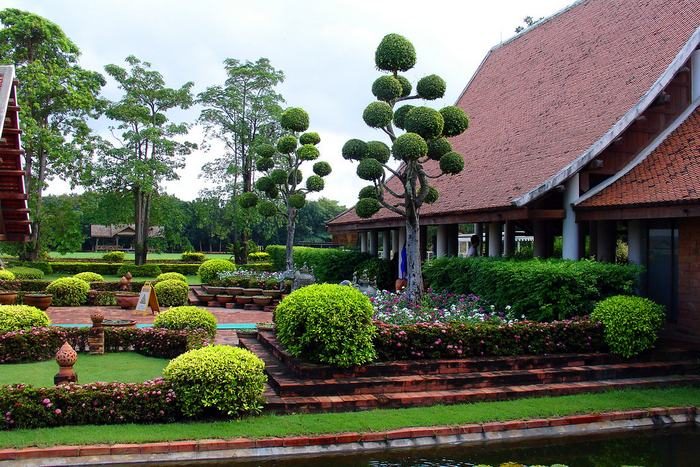
Sukhothai is two places with one name. New Sukhothai is the working town on the Yom River; the walled archaeological site that people come to see sits about 12 kilometres west of it, along Highway 12 towards Tak. The airport is in a third place again, in Sawankhalok district to the north of both.
The walled site is part of a World Heritage property inscribed in 1991, and it is not the whole of that property: the listing covers three towns, of which Sukhothai is one. The province also has a working craft trade in ceramics and textiles, based in its communities. This page covers arriving, getting between the town and the ruins, and what sits outside the walls.
Getting there by air
Sukhothai Airport (THS) is in Sawankhalok district, north of both New Sukhothai and the historical park. Who operates it, what is in the complex and how to get from it into town are covered on our Sukhothai Airport page.
The air leg itself sits on the route pages: Bangkok to Sukhothai for the way in, and Sukhothai to Bangkok for the way home.
Getting from the town to the ruins
Shared songthaews, the pick-up trucks that work as local buses, run between New Sukhothai and the historical park. They are marked Mueang Kao, meaning Old City, and go every 20 minutes from 06.00 to 18.00, leaving from a transport point about 200 metres from the Yom River bridge near the bus station. By road it is Highway 12 westbound towards Tak from the provincial hall, roughly 12 kilometres.
Opening hours for Sukhothai Historical Park are not given on the Fine Arts Department's own pages for the site, and the Tourism Authority of Thailand's attraction record leaves its opening-hours field empty.
What is inside the walls, and what is not
The Fine Arts Department has investigated 217 archaeological sites inside the park, and more than 200 further sites lie outside the rampart on its four sides. The walled town is roughly rectangular, about 1,300 metres wide and 1,800 metres long, with three layers of rampart divided by a ditch. The registered archaeological area is 70 square kilometres, announced in the Government Gazette in June 1975, and the park opened officially in November 1988.
The monuments the Tourism Authority of Thailand names are split between the walled area and the land outside it on all four sides. Admission is charged by zone rather than once for the whole site, taking a bicycle in is charged on top, and the distances involved make a visit a series of short hops rather than one walk. The Tourism Authority of Thailand groups the main monuments as follows.
| Where | Monuments |
|---|---|
| Inside the walls | Wat Mahathat, the central temple; Wat Chana Songkhram in the north of the walled area; Wat Trapang Ngoen to the west; Wat Sa Si, on an island in a pond to the north west; Wat Si Sawai to the south, with Khmer-style prangs |
| Outside the north wall | Wat Phra Phai Luang; Wat Si Chum, which holds a very large seated Buddha image; the Sukhothai ceramics kiln site |
| Outside the west wall | Wat Saphan Hin, with a standing Buddha image |
| Outside the south wall | Wat Chetuphon |
| Outside the east wall | Wat Chang Lom, with an elephant-decorated base; Wat Trapang Thong Lang |
The seated image at Wat Si Chum is known as Phra Achana, the Speaking Buddha, and only four walls of the building around it remain. Wat Chang Lom is also the name of a temple at Si Satchanalai, which is a different park; the one in the table is Sukhothai's.
The World Heritage listing covers three towns
The inscribed property is called the Historic Town of Sukhothai and Associated Historic Towns. It was inscribed in 1991 under criteria (i) and (iii) by the United Nations Educational, Scientific and Cultural Organization (UNESCO), runs to 11,852 hectares, and is a serial property made up of three physically related ancient towns.
UNESCO describes Sukhothai as the political and administrative capital, Si Satchanalai as the spiritual centre of the kingdom and the centre of its ceramic export industry, and Kamphaeng Phet as sitting at the kingdom's southern frontier with important military functions. The three shared a common language and alphabet, a common administrative and legal system, and a common water-control infrastructure. Kamphaeng Phet is in a different province, and all three are run as independent historical parks under the Fine Arts Department, part of the Ministry of Culture.
Criterion (iii) names the group as representative of "the first period of Siamese art and architecture, language and literature, religion, and the codification of law, from which was created the first Thai state". The full entry is on the UNESCO World Heritage Centre's page for the property, and the Fine Arts Department publishes its own account of the Sukhothai park on the department's park office page.
Si Satchanalai, the kilns and the craft communities
Si Satchanalai Historical Park is a separate park on the bank of the Yom River, open daily from 08.30 to 16.30. Those hours are Si Satchanalai's own, and not the Sukhothai park's. Its named monuments include Wat Phra Si Mahathat and its own Wat Chang Lom, which is not the one in the table above.
Sangkhalok ware is thought to take its name from Sawankhalok, the ancient town where it originated, now in Si Satchanalai district. Two production areas are distinguished: the Sukhothai area in Mueang Kao subdistrict, whose wares are coated earthenware with black patterns for household use, and the Si Satchanalai area, whose wares are celadon along with white-coated, brown-coated, two-tone and uncoated stoneware. At two craft communities, Ban Mai Tapung Tong and Ban Koh Noi, visitors can do pottery workshops.
Sukhothai has been a member of the UNESCO Creative Cities Network for crafts and folk art since 2019, a designation the network applies across the province. Its profile names textile weaving, gold and silver ornaments and ceramic and Sangkhalok wares, and counts 1,300 craftspeople working in community-based industries.
The two national museums
Two national museums hold material from the area, and they do not keep the same days.
| Museum | Days and hours | What is there |
|---|---|---|
| Ramkhamhaeng National Museum, Charot Withi Thong Road, Mueang Kao subdistrict | Daily, 09.00 to 16.00 | Artefacts from excavations in both the Sukhothai and Si Satchanalai parks, dating from the 1960s campaigns, with Sukhothai-style Buddha images and Chinese porcelain |
| Sawankhaworanayok National Museum, Sawankhalok district | Wednesday to Sunday, 08.30 to 16.00; closed Monday, Tuesday and public holidays | Sangkhalok ceramics, including pieces recovered from shipwrecks in the Gulf of Thailand |
So a Monday or a Tuesday in the province means the Sawankhalok museum is shut, as does a public holiday.
Loy Krathong at the historical park
The Loy Krathong festival is held at Sukhothai Historical Park each year around the November full moon, under the official title "Loy Krathong, Burning Candles, and Playing with Fire Festival in Sukhothai". The dates move with the lunar calendar, so they are worth checking for the year you are travelling. UNESCO records the festival as the property's peak visitation period, and the evening light and sound performances are ticketed separately from the park itself.
Frequently asked questions
How many days do you need in Sukhothai?
Si Satchanalai is a second historical park with its own gate hours, 08.30 to 16.30 daily, and the two national museums do not open on the same days. Those opening days are what a second day has to be planned around. Sukhothai Historical Park's own monuments are spread inside the walls and outside them on all four sides, in separately ticketed zones, so seeing that park alone means moving between separate areas.
Why is Sukhothai famous?
Sukhothai is one of three towns in a World Heritage property inscribed in 1991, the Historic Town of Sukhothai and Associated Historic Towns. UNESCO describes Sukhothai as the political and administrative capital, and the listing's criterion (iii) names the group as representative of the first period of Siamese art and architecture, language and literature, religion and the codification of law. Separately, the province holds a UNESCO Creative Cities Network place for crafts and folk art.
How do I get from Sukhothai town to the historical park?
Take a shared songthaew marked Mueang Kao from the transport point near the Yom River bridge in New Sukhothai; they run every 20 minutes between 06.00 and 18.00. Driving or riding, it is roughly 12 kilometres west on Highway 12 towards Tak.