!
Latest updates
How to Get to Koh Lanta: Flights, Roads and Ferries
Updated 8th Sep 2026
Things to Do on Koh Lanta: Diving, Old Town and the National Park
Updated 8th Sep 2026
Krabi Province Guide: Airport, Krabi Town and Choosing a Base
Updated 8th Sep 2026
Thailand for couples: which islands and parks close, and when
Updated 8th Sep 2026
Thai domestic flight tickets: fare rules, baggage deadlines and passenger rights
Updated 8th Sep 2026
Udon Thani Destination Guide
Updated 6th Sep 2026
Udon Thani is a city in Isaan, Thailand's north-eastern region, and it is more useful as a base than as a sight in its own right. The reasons to come sit outside the city: two World Heritage sites elsewhere in the province, and the land crossing into Laos.
The border itself is in Nong Khai province, not Udon Thani. Udon Thani is the practical way in for travellers heading for that crossing and for Vientiane beyond it.
Ban Chiang
Ban Chiang, elsewhere in Udon Thani province, was inscribed on the World Heritage List of the United Nations Educational, Scientific and Cultural Organization (UNESCO) in 1992. UNESCO's own dating puts continuous occupation of the site between 1495 BC and about 900 BC, and the listing describes it as a centre of independent cultural and technological evolution in South East Asia from around 1500 BC.
The site is an oval earthen mound, roughly 500 metres by 1,350 metres and 8 metres high. As of 2012, about 0.09% of it had been excavated. UNESCO's entry for Ban Chiang sets out the dating and the criteria in full.
Ban Chiang National Museum is run by Thailand's Fine Arts Department. Its opening days are reported as Wednesday to Sunday, 09:00 to 16:00, with Mondays, Tuesdays and public holidays closed. Those hours come from travel listings, so confirm them before you build a day around it.
Phu Phrabat, listed in 2024
Phu Phrabat, also elsewhere in Udon Thani province, was inscribed on the World Heritage List on 27 July 2024, at the World Heritage Committee's 46th session in New Delhi. It became Thailand's eighth World Heritage site, five of them cultural and three natural. On UNESCO's current list of sites in Thailand, checked in September 2026, Udon Thani is the only province holding two.
What is listed is the tradition of Sima stones, which mark a Buddhist ritual boundary, from the Dvaravati period of roughly the 7th to 11th centuries. Phu Phrabat holds the world's largest group of these Buddhist boundary stones still standing where they were placed, along with prehistoric rock paintings across 47 rock shelters.
The listing covers two separate areas: Phu Phrabat Historical Park, about 576 hectares, and the Sima cultural site at Wat Phra Phuthabat Buaban, about 10 hectares. The Fine Arts Department has administered the park since 1991.
Wat Pa Baan Taad
Wat Pa Baan Taad is a forest monastery south of Udon Thani city, and its name is also written Wat Pa Ban Tat. Ajahn Maha Bua, who lived from 1913 to 2011, began building it in November 1955 on roughly 64 acres of donated land. He was a principal disciple of Ajahn Mun Bhuridatta and one of the most prominent teachers of the Thai Forest Tradition.
Nong Prajak Park
Nong Prajak Public Park is a large public park on the west side of the city, laid out around an artificial lake. The name is also spelled Nong Prachak. Opening times are reported as roughly 04:00 to 20:00.
Nong Han Kumphawapi, the Red Lotus Sea
Nong Han Kumphawapi is a lake in Kumphawapi district, south of the city, marketed as the Red Lotus Sea. The flowering runs from December to February, when the surface turns pink and boat trips across it are the main activity. That narrow season is the thing to plan a visit around.
Despite the name, the flower is botanically a water lily. The lake is a Ramsar-recognised wetland of about 4.1 square kilometres, of which roughly 1.7 square kilometres is open water. The Thai government put it forward for that recognition in 2001.
Ban Na Kha weaving village
Ban Na Kha sits about 16 kilometres north of the city on the Nong Khai road, and it is known for khit-pattern silk and cotton. Travel listings describe it as a daily market and put its hours at roughly 08:30 to 16:30. Neither the daily opening nor those hours is firm enough to build a schedule on.
Going on to Laos
UK government advice records that a visa is required for Laos, that tourist visas have run for 30 days from arrival since 1 January 2025, that an e-visa can be applied for online, and that a visa on arrival is available at major entry points. Check the advice that applies to your own passport before you travel.
All foreign nationals must complete the Lao Digital Immigration Form online, within three days of arrival and again within three days of departure. It applies at the Nong Khai crossing, which that advice lists as Lao-Thai Friendship Bridge I. It replaces the old paper arrival card and does not replace the visa.
Neither the UK nor the Australian government advice singles out this crossing or Vientiane. The UK's only advice against all but essential travel in Laos is for Xaisomboun Province, well away from either. Australia's advice for the country as a whole is to exercise a high degree of caution.
The train from Udon Thani to Vientiane
Since July 2024 a through Rapid service, numbered 147 and 148, has run between Udon Thani and Khamsavath station in Vientiane. It replaced the shuttle train between Nong Khai and Thanaleng, which made its last run as the new service started.
Passengers still clear immigration twice, at Nong Khai and again at Khamsavath. The service is run by the State Railway of Thailand, whose own timetable is worth checking before you plan around it.
Getting to Udon Thani
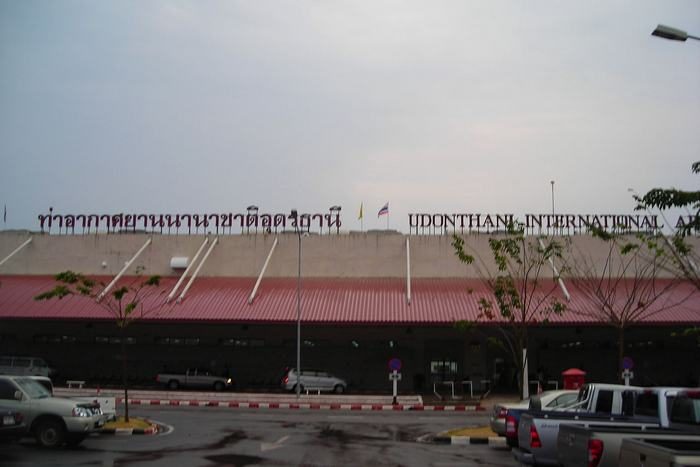
Flights land at Udon Thani Airport, and that page covers the airport itself: ground transport, car hire and which airlines use it.
This site holds route pages for Udon Thani to Bangkok, Udon Thani to Chiang Mai and Udon Thani to Hat Yai. Each carries the typical schedule for that leg and the booking form.
Frequently asked questions
What is Udon Thani known for?
Udon Thani province holds two UNESCO World Heritage sites, Ban Chiang and Phu Phrabat. It is also the practical way in for the land crossing into Laos at Nong Khai, and for the Red Lotus Sea at Kumphawapi in the December to February season.
How old is Ban Chiang?
UNESCO dates continuous occupation of the site from 1495 BC to about 900 BC, on radiocarbon and thermoluminescence evidence. That is the dating the World Heritage listing itself uses.
Is there a train from Udon Thani to Vientiane?
Yes. A through service has run between Udon Thani and Khamsavath station in Vientiane since July 2024, replacing the shuttle train that used to run across the Friendship Bridge between Nong Khai and Thanaleng. You clear immigration twice on the way, at Nong Khai and again at Khamsavath.