!
Latest updates
How to Get to Koh Lanta: Flights, Roads and Ferries
Updated 8th Sep 2026
Things to Do on Koh Lanta: Diving, Old Town and the National Park
Updated 8th Sep 2026
Krabi Province Guide: Airport, Krabi Town and Choosing a Base
Updated 8th Sep 2026
Thailand for couples: which islands and parks close, and when
Updated 8th Sep 2026
Thai domestic flight tickets: fare rules, baggage deadlines and passenger rights
Updated 8th Sep 2026
Nakhon Si Thammarat Destination Guide
Updated 7th Sep 2026
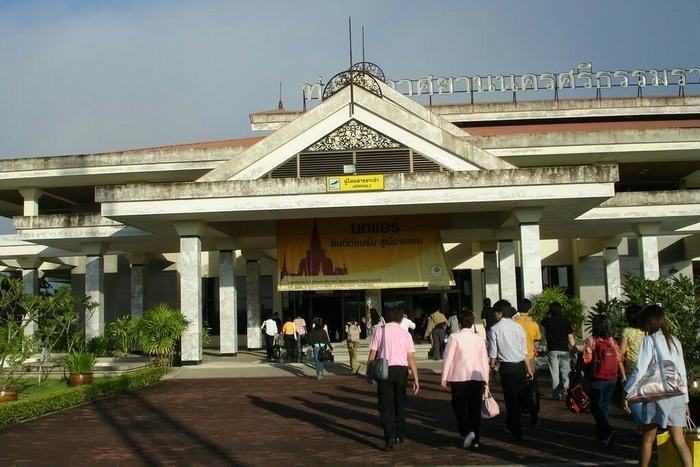
Nakhon Si Thammarat is a mountain and coast province on Thailand's Gulf side. The monastery of Wat Phra Mahathat Woramahawihan was inscribed on the UNESCO World Heritage List in 2026. Inland is Khao Luang National Park; the coast at Khanom and Sichon has wild dolphins, and the Tourism Authority of Thailand describes the province's beaches as undeveloped.
It is southern Thailand's second largest province, about 780 kilometres south of Bangkok, and it has two national parks. The thing to settle before you book is the rain, because this province is wet when much of the country is dry.
Getting there by air
Nakhon Si Thammarat Airport (NST) is the province's airport, and it is run by the Department of Airports. Thai Lion Air, Thai AirAsia, Thai Vietjet Air and Nok Air all filed scheduled domestic services there in January and February 2026, on the department's own flight data. Thai Vietjet Air is the most recent of them: across the whole of 2025 it filed scheduled movements at the airport in one month, December.
The airport handled about 1.12 million passengers on scheduled domestic flights during 2025. Bangkok has two airports, and the department's own data for January and February 2026 names Don Mueang for Thai Lion Air and Nok Air, Suvarnabhumi for Thai Vietjet Air, and both for Thai AirAsia, so check which one your flight uses before you book. The Bangkok to Nakhon Si Thammarat page carries the schedule, and the return leg has its own page for Nakhon Si Thammarat to Bangkok.
From the airport into the city
The airport is north of the city, at Pak Phun in Mueang district. Thailand's aeronautical information publication gives it as 10 kilometres north of the city. The built-up area runs several kilometres from north to south, so how far you actually travel depends on where you are staying.
| Option | Where to find it | When it runs |
|---|---|---|
| Minibus, routes 7 and 8 | Level 1: out of exit door 3, turn left, about 200 metres | Daily 07:00 to 20:30, both directions |
| Metered taxi, yellow and blue | Level 1, next to the minibus stand | Daily 06:00 to 24:00 |
| Limousine | Level 1: counter and stand opposite door 3, about 100 metres | Daily from 06:30 until the last flight |
Minibus route 7 runs to the Hua It bus terminal and uses platform 6 there. Route 8 runs to Robinson and on to Hua Thanon, where the stop is in front of the 7-Eleven at the Pak Phanang bus queue.
The minibus finishes at 20:30 while the taxi rank works until midnight, so an arrival after 20:30 means a taxi or the limousine counter, which the airport says stays open until the last flight. The limousine desk charges a set rate by distance rather than running a meter.
Car hire is available from what the airport itself calls temporary counters, in Building 1 on level 1 by the exit door, plus a booth behind the minibus stand across the pedestrian crossing. The aerodrome entry for the airport lists taxi and limousine under ground transport and nothing else, so book a car before you land.
A counter beside the arrivals hall on level 1 sells van transfers to the pier for Koh Samui, Koh Phangan and Koh Tao.
These details come from the airport's own ground transport page, which is dated March 2022. Check the hours before you rely on them.
When to go, and when the rain comes
On the provincial weather station figures published by the Department of National Parks, November is the wettest month of the year here, averaging 643.1 mm of rain across 22 days. Much of Thailand has its wet season from May to October; this province is not on that calendar, so national advice about when to travel does not transfer here.
The province averages 2,381.3 mm of rain a year and 27.3 degrees Celsius, with April the warmest month and December the coolest. Humidity averages 79 per cent over the year, peaking at 86 per cent in November and falling to 70 per cent in July and August.
The Khanom coast has its own figures, which the Department of National Parks takes from the Ko Samui weather station over 1966 to 1995: a hot season from February to mid-April and a rainy season from May to January, with the northeast monsoon crossing the Gulf from November to January and the heaviest rain in November and December. November is the wettest month there too, averaging 511 mm, and February the driest at 35 mm. The national picture is on our guide to the best time to visit Thailand, and this province does not follow it.
Wat Phra Mahathat Woramahawihan
The monastery was inscribed on the UNESCO World Heritage List in 2026, under criteria (ii) and (vi), as a property of 5.356 hectares.
UNESCO's entry describes it as a major regional Buddhist centre since its founding in the 8th century, on a narrow ridge between the Pacific and Indian oceans, and shaped through transoceanic trade by traditions from northeastern India, central Java, Sri Lanka and the Mon region of southern Myanmar. UNESCO also says religious and local traditions have continued at the monastery for more than 1,500 years, among them the Nakhon Si Thammarat chronicle tradition, the annual cloth-wrapping ceremony for the Great Reliquary, and the Nora dance drama.
Khao Luang National Park and Ban Khiriwong
Khao Luang National Park covers 570 square kilometres across the Phipun, Chawang, Chang Klang, Lan Saka, Mueang, Phrom Khiri and Nopphitam districts. It was announced in the Government Gazette, Volume 91 Part 216, dated 18 December 1974, and is Thailand's ninth national park. The summit of Khao Luang inside this park is 1,835 metres above sea level, and the Tourism Authority of Thailand calls it the highest mountain in southern Thailand.
The department names six waterfalls in the park: Karom, Tha Phae, Phrom Lok, Krung Ching, Nuea Fa and Ai Khiao. The park is set up for nature trails, trekking and camping, and the department flags its birds and butterflies. The shop at park headquarters sells coffee, drinks and snacks daily from 08:00 to 16:30.
Reaching headquarters from the city means Highway 4016 for about 9 kilometres to the Tan House intersection, then left onto Highway 4015 for 20 kilometres to the entrance at Namtok Ka Rom, then 2 kilometres further. The department's own note on this park is that it gets rain all year, because of the height and the humidity.
Ban Khiriwong, in Kamlon sub-district of Lan Saka district, sits on the Khlong Tha Di canal in a watershed area ringed by mountains, Khao Luang among them. It runs porter-led trekking to the summit of Khao Luang, homestays and an ecotourism centre. Its orchards are mixed: mangosteen, rambutan, durian and bitter bean, with a fruit season from July to September.
Village groups make tie-dye, mangosteen soap and dried fruit. There is a swimming spot called Nan Hin Tha Na Ha.
The Khanom and Sichon coast
Parts of the province's coast at Khanom and Sichon fall inside Hat Khanom - Mu Ko Thale Tai National Park, which the Department of National Parks administers as a national park while still listing it as going through gazetting. It covers about 311 square kilometres, of which about 37 per cent is land and the rest sea, and it takes in eleven islands.
Within this province the park covers Thung Sai sub-district in Sichon district and the Khanom, Khuan Thong and Thong Nian sub-districts in Khanom district. It also reaches into the Don Sak and Ko Samui districts of Surat Thani. The department says the area is contiguous, and that some parts were divided out of it to prevent conflict between villagers and the national park.
Its named features include Klang Thong and Tha Noi waterfalls, the Khlong Khanom mangrove swamp forest and Thong Ching Beach. The department lists 18 mammal species for the park, among them deer, wild boar, macaques, langurs, dhole, gibbons and squirrels, along with 140 bird species and 14 reptile species. The department also says the park has no welfare shop, so bring what you need with you.
The high point of this coastal park is a hill also called Khao Luang, at about 814 metres. That is a different mountain from the 1,835-metre Khao Luang in the inland national park, and not a second measurement of the same peak.
The dolphins off Khanom
The pink dolphin off this coast is the Indo-Pacific humpback dolphin, Sousa chinensis. Its colour changes with age: dark grey when young, grey-white in some adults, and whitish or pink in older animals. It travels in groups of 10 to 40, swimming slowly close to the shore.
It is not the Irrawaddy dolphin. That is a separate species, Orcaella brevirostris, which also swims off this coast, and the Department of Marine and Coastal Resources records the two separately.
The humpback dolphin is a protected wild animal under the Wild Animal Reservation and Protection Act B.E. 2535 (1992), and it is listed on Appendix I of the Convention on International Trade in Endangered Species (CITES). That department's survey of 1 July 2022 counted about 19 humpback dolphins along the Don Sak coast in Surat Thani and Khanom district here, including five mother-and-calf pairs, plus three to four Irrawaddy dolphins off Khao Ok in Khanom. A survey in June 2020 recorded 12 humpback dolphins between the Don Sak pier, Ao Talet in Khanom district and the Sichon river mouth.
The 2022 survey also recorded what the animals live alongside: marine litter in their habitat, including face masks, boat traffic crossing their feeding ground at the mouth of the Don Sak canal, and oil and rust at Racha pier from boat repairs. Sightings are made from boats, and these are wild animals rather than a fixed attraction, so a trip can come back with nothing.
Nora, shadow puppets and the museum
Nora, the dance drama of southern Thailand, was inscribed on UNESCO's Representative List of the Intangible Cultural Heritage of Humanity in 2021. UNESCO describes it as a lively and acrobatic form of dance theatre and improvisational singing, opening with a long oral invocation and built around a lead dancer and an ensemble led by a traditional southern oboe. UNESCO's World Heritage entry for Wat Phra Mahathat lists the Nora dance drama among the traditions that have continued at the monastery.
The Tourism Authority of Thailand describes the region as famed for nang talung, the southern Thai shadow play performed with handmade leather puppets, and calls the city a good place to see a performance. It points to the studio of Suchart Subsin for authentic handmade puppets. Shadow-puppet carving has been practised in southern Thailand for more than 200 years, the puppets carved and punched from tanned leather and traditionally coloured with soot from clay pots.
The National Museum of Nakhon Si Thammarat, in Mueang district, opens Wednesday to Sunday from 09:00 to 16:00 and closes on Mondays, Tuesdays and public holidays, so a Monday or Tuesday visit will not work. The Fine Arts Department, which runs the museum, also names yan lipao basketry as a craft of this province.
Frequently asked questions
Is Nakhon Si Thammarat worth visiting?
It suits a traveller who wants a World Heritage monastery, a 1,835-metre mountain with waterfalls and a porter-led trek from a working village, and a coast with wild dolphins off it. The Tourism Authority of Thailand calls the province's beaches undeveloped. Its heaviest rain falls in November and December, when much of Thailand is drying out.
What is there to do in Nakhon Si Thammarat?
The main draws are Wat Phra Mahathat Woramahawihan and Khao Luang National Park, with the six waterfalls the department names and the summit trek from Ban Khiriwong. On the coast at Khanom and Sichon there is Hat Khanom - Mu Ko Thale Tai National Park and the humpback dolphins. In the city there is the National Museum and nang talung shadow puppetry.
When is the rainy season in Nakhon Si Thammarat?
November is the wettest month, averaging 643.1 mm across 22 days at the provincial weather station. On the Khanom coast the Department of National Parks puts the rainy season from May to January, with the heaviest rain in November and December and February as the driest month. That is close to the opposite of the May to October wet season that covers much of the country.
Which airlines fly to Nakhon Si Thammarat Airport?
On the Department of Airports' flight data for January and February 2026, the carriers filing scheduled domestic services at the airport were Thai Lion Air and Nok Air from Don Mueang, Thai Vietjet Air from Suvarnabhumi, and Thai AirAsia from both. Thai Vietjet Air is the most recent arrival, appearing in the department's 2025 data from December. The route page for Bangkok to Nakhon Si Thammarat is where to check what is currently scheduled, and which Bangkok airport it leaves from, before booking.
How do I get from Nakhon Si Thammarat Airport into the city?
A minibus on routes 7 and 8, a metered taxi rank and a limousine counter all sit on level 1, within about 200 metres of exit door 3. The minibus runs daily from 07:00 to 20:30, the taxi rank from 06:00 to midnight, and the limousine counter from 06:30 until the last flight. The airport page giving those hours is dated March 2022, so confirm before you count on the last minibus.